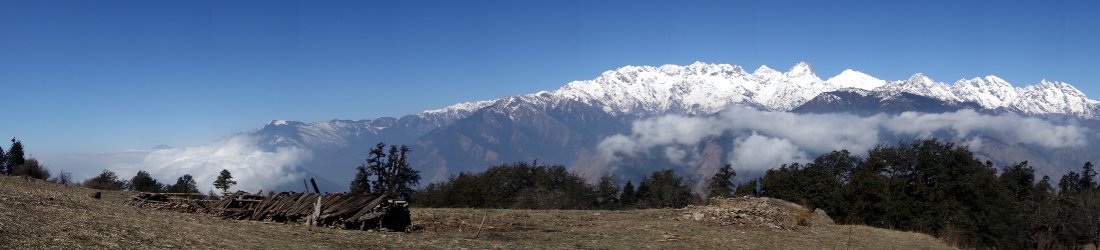

‘This small village, with scarcely any fields, seemed to live by what it could fleece from travellers – which, I thought, would be very little judging by what they had to offer and the kind of traveller who passed through. It is a dull place, like the other villages on this rather dull trade route where neither mule-trains with jingling bells and scarlet wool-tufted harness, nor tea-houses where the picturesque muleteers foregather, are met.’H.W. Tilman, Nepal Himalaya
These were the somewhat churlish words of the great mountain explorer Bill Tilman, when he became perhaps the first ever foreign tourist to arrive in the village of Syaphru Besi (also spelled Syabrubesi) in 1949.
By the time I arrived there in 2007, it had grown into a thriving centre at the end of the road from Kathmandu, serving both tourists wishing to access the popular Langtang trekking area and traders crossing the Chinese Tibetan border a few miles further north.

I arrived with two Nepali friends to conduct a reconnaissance of the newly opened trekking route west of Syaphru Besi known as the Tamang Heritage Trail. Having survived the journey on a crowded local bus that wasn’t designed for people my size, I found the main street a bit cramped and dusty, and I was happy to retreat into a comfortable teahouse called the Buddha Guest House just above the road.
The following day, I was in a better position to appreciate the village as we started our trek by climbing the hillside above it. For a village situated deep within the Himalayas and close to the Tibetan border, it lay at the comparatively low altitude of 1,460m, at a confluence where the main north-south Bhote Khosi / Trisuli rivers are joined by the Langtang river arriving from the east. It was a village of two parts. The main, more modern centre had been built on the west bank of the Trisuli, while the older part lay across the river at the foot of the Langtang valley.
The village was surrounded on all sides by steep, forested hills. Indeed the setting can fairly be described as one of the deepest gorges in the Himalayas, with the peaks of Ganesh (7,422m) and Langtang Lirung (7,227m) just 35km and 20km away on either side.

By the time I returned to Syaphru Besi four days later, having slept in basic homestay accommodation and brought most of my dinner back up in Timure the previous evening, the village felt like a metropolis, while staying at the Buddha Guest House felt like a night at the Ritz. I discovered that my illness had simply been dehydration – in particular, salt deficiency. I had been able to keep up with my friends, but I had sweated buckets. While I had replaced the water by drinking litres and litres, the salt I had not. At the Buddha Guest House I ordered a plate of chips, and sprinkled over some salt. Then, with every chip I ate, I sprinkled on some more. By the end of meal I was feeling fine again, and this time I kept it down.
I returned to Syaphru Besi with Edita ten years later, in 2017. We’d had a sobering experience in the village of Langtang, which had been wiped out by a rock avalanche from Langtang Lirung during the earthquake two years earlier. Only a single house remained, which had been wedged up against a cliff face. A massive area, perhaps a mile wide and two miles long had been swept by a sea of grey rock, from the canyon walls to the river. The area had been so devastated that there was not a single shred of evidence that there had ever been a village there. It remains one of the most devastating scenes I have ever witnessed.
Syaphru Besi had grown a bit since my first visit. There were a few more houses and three-storey hotels, but it was still recognisable. In 2007, it had been at the end of the road, but by 2017 the road continued to the border checkpoint at Rasuwagadhi, and onwards into Tibet.

I had preferred the smaller village, but we often say that about progress. We were able to get a hot shower in our teahouse, the Namaste Hotel, but when we tried to explore the village and find a nice bar for a drink, we discovered there was nothing to explore. Despite Syaphru Besi’s dramatic setting at a confluence of two rivers that flowed through deep gorges, little had been done to make the place pretty. I imagined a teahouse with a pleasant terraced garden among trees, with a beautiful view high above the river. All of the ingredients were in place: the grass, the trees, the hillsides, the river and the gorge. But nobody had put them all together with the care and attention it required. Syaphru Besi still felt like quite a poor place, and in poor places survival comes before homeliness.
We did get some entertainment though. Edita discovered all the porters from our trek outside a tin shack that was the village barber’s shop. I agreed to get a shave after three weeks without, which for me meant the whole of my head. Many passers-by stopped to watch, and I became quite an attraction.
Afterwards we sat on the terrace beside the road in front of our teahouse, drinking beer and watching the world go by. The bus arrived from Kathmandu and deposited its load of backpackers and locals. A wedding party came past, dressed up in the back of a lorry. The army trooped past on a run, and another truck stopped by to unload some cement. We reminisced about our trek. We looked forward to civilisation again, but reflected with fondness on the simple life we were leaving behind, among some of the most beautiful mountains on earth.

I don’t think that either of us suspected that less than ten years later, Syaphru Besi would suffer the same fate as Langtang village.
On 26 August 2026, another glacier collapsed on Langtang Lirung. This time, instead of collapsing to the south into the Langtang valley, it fell on the north side into the Lende Khola, a tributary of the Bhote Khosi / Trisuli river that passes through Syaphru Besi. An avalanche of rock and ice tumbled 1,200m. Friction converted the ice into water, raising the river level by 70m beneath it, and by 9m thirty minutes downstream. An unimaginable 55 million tons of rock and ice were carried with it, passing some places at speeds of 150km/h. Over 7,500 homes were destroyed, bridges were swept away and roads buried. At the time of writing, 1,400 people have lost their lives and over 5,500 more are still unaccounted for.
Apart from clusters of houses higher up the mountain slopes, most of Syaphru Besi was buried by mud. This sobering report by CNN reporter Anderson Cooper shows that the places where we sat – the teahouses, the bus stops, and the little tin shack where I had my hair cut – are now buried beneath metres of concrete sludge, formed by ice, rocks, trees and everything else picked up and carried by the deluge.
He is standing in the area that was once the main street. The Namaste Hotel is almost certainly lying somewhere beneath his feet, as is the Buddha Guest House. There is a harrowing story on the Nepali site Online Khabar, about the 91-year-old father of the Buddha Guest House’s owner. On the day of the flood, he and his wife went to a funeral in a village higher up the hill. By the end of the day, not only was their prosperous hotel flattened, but they had lost three generations of their family.
Before-and-after satellite images on the BBC website show the extent of the mudslide. What remains of the village is now divided into four sections, each unreachable from the others. The bridge and road were swept away; the mud is like quicksand and cannot be crossed. It’s simply not possible to walk from one part of the village to another.

And what of the future? I know from experience that, shocking as these events are, the people and places affected can recover quickly. Two years after the devastation in Langtang, a new village was emerging a short distance above the first one, which had lain in a vulnerable location beneath an avalanche gully. The two villages are barely 100m apart and it’s conceivable the new Langtang could grow to become something very similar to the old one.
It’s hard to see how the same could happen with Syaphru Besi. When I travelled there by bus in 2007, I had been surprised when the bus turned away from the main Trisuli valley to climb 1,000m up a hillside in a relentless series of zigzigs. It was surely much harder to build a road up that hillside than to continue it along the valley floor, so why did the main road go that way?
Obviously, I know the answer now. The road passes through a larger town called Dunche, situated in a flattish basin high on that hillside, before descending on more zigzags to Syaphru Besi. It would be foolhardy to rebuild Syaphru Besi down in the valley again; any new houses would need to be pitched high on that steep hillside. Can it become a bustling centre once again, and the main jumping-off point for the Langtang trek, the Tamang Heritage Trail and the pilgrimage trail into Tibet?
I wouldn’t bet against it. Perhaps one day there will be that teahouse with a pleasant, terraced garden among trees.


I did the Langtang trek in 2013 so was also privileged to have been to Langtang Village (and Syaprubesi but my recollection of it is not so great). Really loved Langtang Village and was so sad when I read about the earthquake. Now this! Worst of all is I know someone who was on her way to a Mt Kailash pilgrimage and has been missing since. It really makes it hit home!
Hi Mark,
I´m sure you are remembering now all the people you met there and that their fate is filling you with deep sadness.
I remember I had this when the WTC in New York was destroyed by Muslim terrorists in 2001, just a few years after me and my wife went up there.
I remembered for instance the lady of the souvenir shop on the top floor etc. And all the office people on the top floor of the other building where we erroneously first went up but which appeared not to be open to the public.
But I´m sure your sorrow will be much more intense than mine.
Trekked this area in 2019.
Spent an evening in Syaphru Besi and often think about the Tibetan wedding taking place in the street below or rooms in our T-House and all the locals I met there. Most of them gone or misplaced now.
Seeing the destruction of the Langtang village back then was tragic but this seems even worse.
Life is not easy in Nepal.
I was there last November. I stayed at the Royal Himalayan Hotel, 1 night before the trek, 1 night after. I drank beer with the owner of the hotel and talked about life the night before we set off for Kanjin. I was so deeply upset when I saw the day after photo, the hotel was gone, the man I had shared an hour with , probably dead. My thoughts are with Nepal at this time and with the friends I have made on several trips there.
Thanks for sharing your memories of Syabrubesi. I was there in 2022 – the starting point for my Langtang trek – and the village was my first thought when I saw the photos of the floods.
I don’t remember the name of the lodge where I stayed, the very hospitable owners who ran it, or even have photos of the area. The drive there had exhausted me, and I was too exhausted to document the moment.
Life moves quickly and it’s a reminder that we should make the effort to document the places we visit and the people we meet.
Reading this was genuinely moving, Mark — the fragility of these trailhead villages hit me hard. I trekked in Nepal’s Upper Mustang back in 2019, and the remoteness there feels even more precarious: the walled city of Lo Manthang and centuries-old cave monasteries hanging on through sheer local grit. For anyone daunted by the long approach on foot, an upper Mustang jeep tour makes that same stark country and its people accessible without the multi-day hike. Whether on foot or by vehicle, visiting is one of the few ways these remote Himalayan communities can sustain themselves, so stories like this matter more than ever. Thanks for writing it.