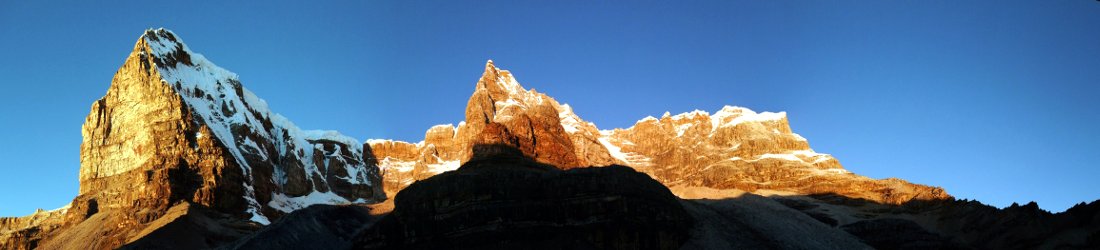

This is the second of two posts about Lhakpa Ri, a mountain in Tibet first climbed by Bill Tilman and Edmund Wigram in 1935. In the first post I described that historic ascent. This second post features an excerpt from my diary describing my own ascent of Lhakpa Ri 72 years later.
I climbed Lhakpa Ri on 11 May 2007 as part of a commercial expedition by UK mountaineering operator Jagged Globe. The leader of that trip was an Australian mountain guide called Mic Rofe, who also led us up to the North Col of Everest two days later.
Two of my companions that day were Mark Dickson and Ian Cartwright, who feature in several of my published books and diaries. Five years later, all three of us would reach the summit of Everest together.
After trekking from Everest Base Camp up to Advanced Base Camp on the north side of Everest, we spent 4 nights acclimatising there before making our attempt. We spent some of this time on the East Rongbuk Glacier, learning rope and climbing skills with Mic’s expert tuition.
———
At long last, after days of waiting around doing very little, it’s time for some hard physical exercise. We’re woken up with bed tea at 4.30am, but it takes me nearly an hour of faffing before I’m ready to depart. I put on several warm layers; my salopettes, which prove impossible to put on inside the tent; double-layered mountaineering boots; gaiters; down jacket; windproof outer layer; my harness with abseil device, jumar and safety carabiner attached; balaclava; sunglasses; neck buff and warm hat. I finish by putting on warm gloves after getting my fingers icy cold sorting everything else with just my inners. I grab my ice axe and have only my crampons left to fit to my boots down on the glacier before we set off. After swallowing a quick breakfast we’re eventually ready to leave at 5.50.

It’s now light, which makes things a little easier. We start by crossing an icefall onto the main East Rongbuk Glacier. This section is very short, but I know it will feel much longer when we return through it later in the day. The ice is dry with no fresh snow, allowing us to spot any crevasses before we fall down them.
Once through the icefall, we rope up and head up into a blank basin of thick snow coloured a soft grey in the dull dawn light. Above the basin, two peaks rise above us. The one on the left is flat-topped like the ridge of a tent [this is the second Gardefui peak described in the previous post]. The one on the right, Lhakpa Ri, is slightly higher and rises to a rough point like a clenched fist. Our first destination is the col between the peaks, known as the Lhakpa La. Here we will turn right, along a faintly rocky skyline to the summit. This skyline is our only view of the earth’s surface: between us, the land is entirely submerged in snow and ice.
I find myself at the back of a rope of five, led by Sangye, with Tim, Ian and Mark in a line behind. Tim is the oldest in the group, but Ian, Mark and I have been the quickest until now. If we were worried about him slowing us down, we soon discover that his pace is far from sluggish.
There isn’t much to tell you about the first four hours of the climb. We plod monotonously through deep snow, rising gradually higher into the bowl. The sun is rising above the col, but it never really manages to burn a hole through the dense cloud. Behind us, blue sky appears tantalisingly above the North Col; and the steep cliffs beneath Changtse’s east ridge provide some contrast. They are so steep that hardly any snow clings to their chocolate-brown surface. The summit of Everest, however, hides regally behind dense clouds.

As we ascend, we angle slightly to the left, then back to the right to skirt beneath a subsidiary ridge of the tent-shaped peak [this is the rocky rib that Tilman and Wigram climbed on their first ascent]. After four hours we reach a 150m section of fixed rope below the col. It seems strange to find it here, a thread of human interference in this blank wilderness. The angle of the slope is gentle and we don’t bother to clip in using the technique that Mic showed us. A short distance above it, we take a rest. My altimeter reads 6,700m, which means we’ve climbed about half of the vertical distance.
Just above us on the same crest of snow is the Lhakpa La – the high pass that Mallory crossed in 1921 as he looked for a way to the North Col. For him, reaching the pass was a triumph. He could now see a clear route up to the North Col and the summit of Everest, but nobody ever came that way again. While Mallory had been beating a route to the Lhakpa La from the remote Kharta Valley, his teammate, the geographer Oliver Wheeler, had quietly mapped the more obvious approach up the East Rongbuk Glacier that Mallory had missed.
We never make it to the Lhakpa La. Instead, Mic turns right up the snow slope beneath it, to skirt beneath the rocky skyline we had seen from ABC. It’s physically exhausting. We climb through an area of crevasses. Mic now takes over the lead with the slower rope team of Chris, Petr, Bunter and Nima Dendi. Things are no longer so straightforward. From time to time there is a cry of ‘stop’ when somebody puts a leg in a hole right up to their thigh. Our ropes come to an abrupt halt as we wait for the victim to extricate themselves. But this is as bad as it gets – nobody falls right in, and we pass through this hazardous area without mishap.

The slope becomes steeper the closer we get to the summit. Our pace slows right down as the thin air cuts into our lungs and we gasp for breath. We plod only 20 or 30 paces at a time before stopping for a rest. These stops become longer as Chris and Petr sit down in the snow to get their breath back.
I look up at the steepening snow slope converging to ridges on either side of us. The point of convergence appears to mark the summit, but before we reached the col I noticed a higher summit behind it. We are climbing straight up the middle of the slope, where the snow is deep. Despite our painfully slow progress, everybody seems determined to keep going.
Then Mic, exhausted from breaking trail, asks someone else to take over. The gentle whirr of the wind cuts through the air and I imagine a bell tolling somewhere in the distance. We look across at Sangye and Nima Dendi, but they stay where they are. It suddenly dawns on me that not all Sherpas are the tigers of the snow that we believe them to be. Far below us, in that village of tents at ABC, are the premier league footballers of the Sherpa world, ready to climb to the summit of Everest with the Manchester Uniteds and Chelseas of mountaineering outfitters. Somewhere on the other side of the mountain is camped a similar array of superstars. Ours may have trained with them once, but they’re now playing in the lower leagues with Torquay United. After a few seconds of tense silence, Mic’s team reverses the order of their rope, and Nima Dendi leads off.

We reach a short rocky section. It’s not terribly steep, but Mic decides to tie a fixed rope for safety. The fresh snow has hidden a layer of rock beneath the surface, and now we can’t see what we’re treading on. Chris and Petr are digging deep now, into reserves of energy that are rarely used. They struggle to ascend a short rock slab. They swing backwards and forwards, exhausted, and dangling by their jumars from the fixed line. Mark and I are right at the back. By the time we come to climb this section, we have waited a long time, but we cross it easily.
We now have an easy scramble to the top of the ridge that marks the north summit, but progress is painfully slow. Petr falls over next to me. I assume he is exhausted and I make some friendly comment before moving on. But Bunter, below him on the rope, is more concerned. He shouts at him to tighten the rope and stay where he is.
He scrambles up to where Petr is waiting. ‘Who is Klara?’ he says.
Petr’s daughter Klara is somewhere down at Advanced Base Camp with a separate expedition team, hoping to become the first Czech woman to climb Everest.
‘Klara – why, my daughter, of course,’ Petr replies.
I feel a bit embarrassed. Bunter seems to be treating Petr like a small child, bullying him to get moving. But Bunter is concerned that Petr is showing signs of altitude sickness. Later, I hear both Petr and Chris express their gratitude to Bunter for his help during the climb. I guess some people appreciate different levels of assistance.

We have another delay just a few feet short of the north summit. I stand in an awkward position on steep snow, a hair’s breadth from the top, cursing another delay. Eventually, instead of moving in a line on our ropes, we all step up to congregate on the crowded summit. I can immediately see what the problem is. Sangye is waiting on the narrow snow-capped north summit looking across at the marginally higher south summit. The two peaks are connected by a narrow ridge of snow, but it is fresh rather than consolidated, and therefore much less stable. Were it to fall away, we would tumble hundreds of metres down to a crevasse-riddled glacier. Sangye is unsure about continuing, and after a brief discussion with Mic they decide this is as far as we go. To brave the ridge would mean to risk triggering an avalanche.
I look at my altimeter. It’s reading 7,005m. I have the consolation of climbing above 7,000m for the first time in my life. It’s 3pm, and it’s taken us nine hours to reach here – much longer than we anticipated, though the fresh snow made our ascent considerably harder.
It continues to snow heavily for most of the descent. The tracks we made on the way up have been obliterated. At times visibility is only a few metres – this makes navigation more difficult and it’s hard work breaking trail for a second time. We descend the fixed ropes by means of the Klemheist knot that Mic taught us in base camp. We share a single rope for much of the remaining descent. Initially Chris leads. When he has difficulties seeing the trail, he swaps with Ian, but Ian also has one or two problems: the path through the crevasse field has disappeared, and he needs to make a new one. This time I’m the idiot who falls in a couple of times. But my rope mates dig in to the snow with their crampons and axes, holding me in position until I climb out again.

There is a more embarrassing incident when I take off my pack to put another layer on. I put down my camera bag and it starts sliding down the hill.
‘Whose is that camera bag?’ Bunter says.
‘Mine,’ I reply.
It’s going so slowly that I’m certain it will soon come to a stop.
‘Don’t worry, it’ll stop rolling soon,’ Ian says.
‘I wouldn’t be too sure,’ Bunter replies.
The camera bag slows and I breathe more easily, but then it picks up speed again. By now it’s about 50m below us, and heading directly towards the ominous black line of a crevasse.
‘Stop! Stop, you bastard!’ I cry.
The bag doesn’t listen. It now seems certain that my camera is doomed. All my teammates are watching tensely. I start to wonder how deep the crevasse is and whether the bag can be recovered. Then, suddenly and inexplicably, it comes to rest about a metre short of the black line.

Everyone laughs, but it’s not over yet. As we tramp down towards it, I’m almost certain it will drop over the edge as soon as somebody gets within a metre. The fast team of Ian, Mark, Tim and me, head lightly for the crevasse. Ian stops short in case of an overhang beneath him, and hooks the bag off the ground with his ice axe. On the rope behind us, Bunter and Chris start cheering. My companions pass my camera along the rope, but Mark wisely decides we’ve had enough good fortune and slings it over his shoulder. As we move past the crevasse, I note the trail left by the camera bag in its tumble down the hill. There’s no obvious reason why its journey came to an end, but I’m relieved it did. Perhaps our puja worked and the mountain gods were smiling on me. The crevasse looks deep.
Our descent drags on as the light becomes dimmer. At the lowest point on the glacier, we’re met by Kaji and Pasang with some mugs and a flask of hot lemon. It’s a nice gesture, but it means yet another delay – I just want to get back to camp and drink hot liquid while sitting in a nice comfy chair in the mess tent.
The snow has stopped now, and the clearing cloud affords us our first view of Everest as the evening sun touches the North Col high above us. I realise just how fantastic the view from the summit of Lhakpa Ri would have been had the weather been kinder. We cross the icefall as the evening light dims to pitch blackness. I fall into three crevasses. The last of these I see quite clearly; I make a running leap, but I don’t notice that the ground drops away by a foot immediately in front of it, and I end up catapulting myself right in. Then I trip over an invisible snow ridge and get cramp in my right leg.

‘Stop,’ I shout to the others in front of me. ‘I think I need to put my head torch on.’
Mark turns around. ‘Why don’t you take you sunglasses off, you idiot?’ he says.
‘It’s still light, isn’t it?’ I say.
He nods slowly. I take off my glasses, and the world is suddenly brighter.
If our blundering sounds amateurish, then all I can say in our defence is that better men than us have found themselves in a similar predicament. When descending the North Ridge in 1922, the Everest legends Edward Norton and George Mallory came across a similar crevasse field on their approach to the safety of their North Col camp. They struggled through it by the light of a candle lamp. At least my head torch isn’t going to get blown out by a gust of wind.
We reach camp at 7.30pm, after more than 13 hours of exertion. Nobody feels like eating. We sit in the mess tent, swallowing a few mouthfuls of tea and trying to get some warmth back into our bodies. In two days we hope to climb to 7,000m again, on the North Col of Everest.


