
My travel diaries
Thursday 9 August, 2007 - Muztag Ata Base Camp, Xinjiang, China
A panoramic viewpoint
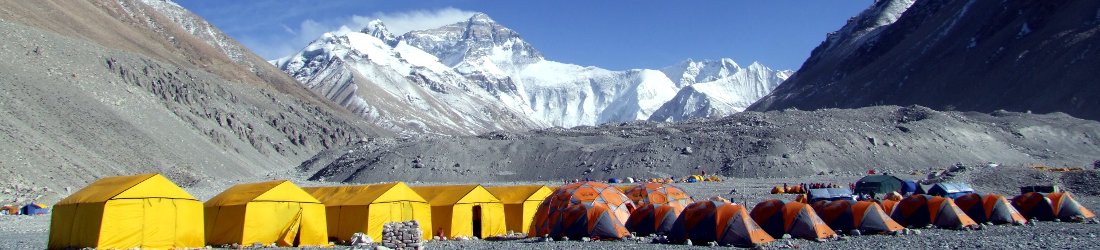
Another rest day in Base Camp. In the afternoon I ascend some distance up the valley of the stream which flows through camp. It curls around to the right, and I divert up to a cairn and find myself on top of the moraine mound directly above our tents which I tried to scale directly a few days ago. From here I have a superb panorama of the plains below looking across to the light brown hills which mark the border with Tadjikistan. I can see all the tents of base camp, and behind them, beyond a shoulder of Muztag Ata, is the snow-capped ridge of Kongur. To my right I can see the trail all the way up to Camp 1, 900m above me. Tiny figures are crawling all the way up it, but Camp 1 itself is visible just below the horizon, where the snowline begins. It's strange to think that the summit is still 2000m above the horizon, yet none of that distance can I see from where I am. Muztag Ata is a domed mountain whose slopes become gentler the higher it rises. Any one point on the horizon could hide a great deal of mountain. I hope to see more of it the day after tomorrow.
I spend about an hour sitting on a rock surveying the panorama before I descend. It's one of those magical moments when I feel privileged to be where I am, a sight few people will ever get to see.
Marmot studies
Back at the tents Juliet describes a location to me where there are plenty of marmots to be seen. I follow her directions and ten minutes later find myself sitting on another comfortable rock looking up at a small hillside crawling with about half a dozen large golden rodents. I manage to get to within about ten yards of two of them before one of their companions utters a loud, shrill warning shriek from an adjacent burrow and they disappear underground.
I return to my rock and decide to wait for some more action. Sure enough, it's less than five minutes before they re-emerge. One is confident enough to hop along the hillside only about 20 or 30 yards from me while another keeps sentry from an adjacent burrow. I watch its golden brown fur glimmer in the sun for several minutes as it strides from rock to rock munching on the occasional tuft of grass. When I stand up to leave I notice little rodent heads poking up from holes all over the hillside, a bit like a scene from The Muppets .
Feral porters
Before dinner Geoff has all his equipment out lying on rocks around the tent as he prepares for ascending the mountain tomorrow. There are four Kirghiz peasants sitting on rocks only a few feet away watching him pack. I have noticed this is a common trait, not only here but in Tibet where I was in May. It is both disconcerting and appears to be extremely impolite to our western sensitivities. I ask them why they are watching him, even though I know it's no more than a cultural thing. They are interested in Geoff's things not because they want to steal them, but because they are merely curious.
But I discover there is another motive when I try to strike up a conversation. These men have donkeys and hang around base camp hoping people will pay them to carry kit up to Camp 1. David describes them as 'feral porters', and he says Muztag Ata is one of the few mountains where he's seen this sort of thing going on. In wild locations, porter services can usually be obtained in a village or through some form of local agent, but here on Muztag Ata donkey men just wander around pouncing on people if they are observed to be packing.
My intervention turns their attention upon me rather than Geoff. I'm interested in where they come from, how many months of the year they spend on Muztag Ata, and what they do for a living when the climbing season ends. Unfortunately, though their English is quite reasonable when it comes to negotiating rates of pay, that's the only English they know, and I can't find a single other English word they understand beyond weights, numbers and dollars. Even my sign language gets me nowhere, although my indifference to bartering leads to my being offered a discount rate of $1 per kilo. Later, when I leave them and walk away to a nearby rock to write my diary, they follow me over and sit within an inch of me watching me write. Their proximity makes it very difficult for me to concentrate, and every time I look up they quote me a figure. But I achieve my purpose, and by the time they leave Geoff has finished his packing.
In the mess tent that evening there is talk of catching a marmot to roast for supper. The behaviour I observed earlier in the day makes me sceptical about whether this is possible. We can hear their squeaking echo from hillsides all around the camp, and clearly none of them venture above ground without another keeping a sentry position nearby. There appear to be so many burrows that there is always somewhere to escape within just a few feet. Besides which, their resemblance to giant guinea pigs discourages some members of the group. While David, Toby and Lindsay were in Ecuador together a few years ago, where guinea pig is a local delicacy, they had an unfortunate experience in a guinea pig restaurant (yes, apparently there is such a thing). The cooked guinea pigs were brought to their table looking not very different to how they look when alive. The whole animal sat on their plates, staring at them plaintively. The following day, their entire expedition team had food poisoning and their ascent of Cotopaxi was a struggle.
Previous 1 2 3 4 5 6 7 8 9 10 11 12 13 14 15 16 17 18 19 20 21 22 23 24 25 26 27 28 Next
Message board >>
- Bookmark site with
del.icio.us - Post site to
Facebook

